

Setting Sail on the Internetic Ocean
A website is a hull with a name you chose on a Tuesday and believed in on a Friday.
It sits there at first – new paint, clean lines, bright optimism – resting in a harbor made of bookmarks and good intentions. You can walk around it in your mind, admire it from angles nobody else will ever see, and still it won’t do the one thing it was built to do.
Move.
That’s what the first blog post is.
Not “content.” Not “a deliverable.” Not a box ticked on a marketing checklist so you can sleep at night. It’s the moment you stop polishing the ship and let the sea have a say.
It’s the champagne against the bow, the laugh that’s half courage and half denial, and the soft release of rope from dock cleat to open water.
So here it is.
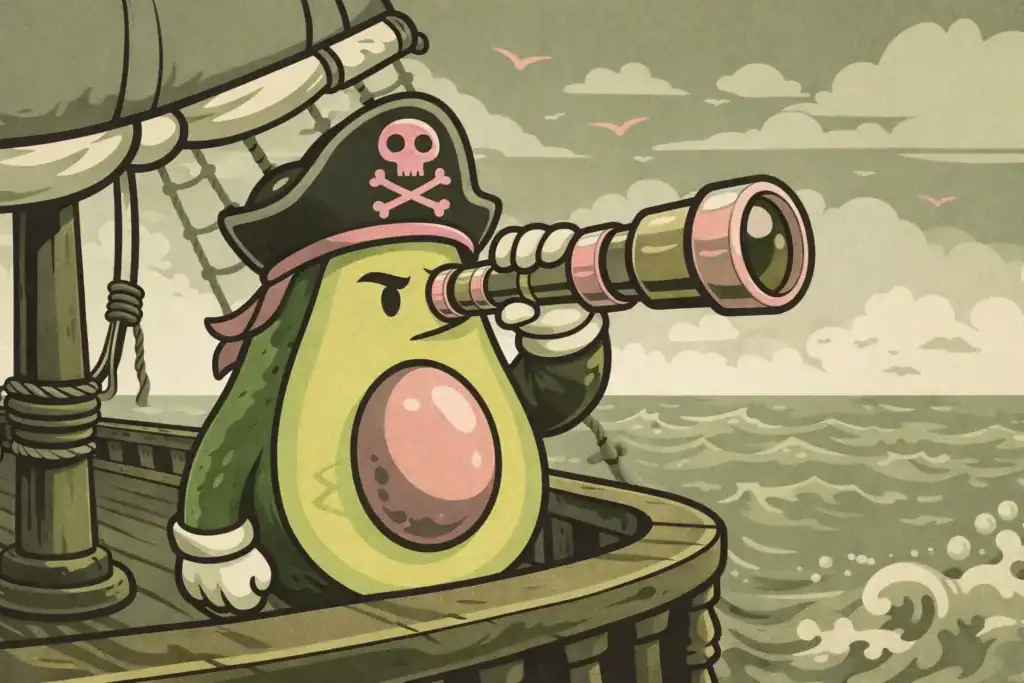
Ready to chart a course?
If you want to see what your marketing map should look like, send us a message with two things:
> what you sell, and
> what’s currently not working.
We’ll reply with one clear route we’d take to get you discovered – and what treasure we’d stop wasting on the way.
The first splash.
If I could, I’d paint the name in gold leaf and confidence: USS Avocads—a proper thing, the kind that looks good on a stern and even better in a story. But I don’t have a USS. I have a protocol and a promise. I have https://, which is less romantic, but more honest about the era we live in.
Different times.
In older waters, danger came with a flag and a cannon and a man with terrible teeth yelling about your cargo. Out here the pirates are polite. They wear clean fonts and they call themselves “growth hackers.” They promise treasure and sell you sand. They don’t board your ship with grappling hooks; they board your inbox, your analytics, your attention. They don’t steal your food and water.
They steal your time.
And there is no fishing here.
Only phishing.
Still—ships are made to leave. That’s the point. A website that never sails becomes a museum. A beautiful one, maybe. People walk past it and say, “Nice,” and keep walking.
We didn’t build a museum.
We built a ship.
And like every ship, it needs three things before it can become anything more than wood and hope:
- A destination (even if it’s only a guess at first).
- A map (even if it has blank places and warnings written in the margin).
A crew (the kind that knows when to cut weight, when to patch leaks, and when to take the longer route because it’s safer).
Marketing is the mapmaking.
Sometimes it’s elegant cartography—clear lines, measured distances, predictable routes. But often it’s the other kind: hand-drawn, half-rumor, half-data, with little notes scrawled beside the reefs.
Here be algorithms.Here be competitors.Here be a storm named “Low Intent Traffic.”Here be the shallow waters of “Pretty, But Doesn’t Convert.”
You can sail without a map, of course. Many do.
They drift from trend to trend like flotsam. They attach themselves to whatever current is loudest that week. They throw keywords overboard like ballast and call it strategy. They measure the sea by how it flatters them on the day.
But eventually the wind changes, as it always does, and the sea reminds them that vanity metrics don’t keep a ship afloat.
A ship afloat needs something sturdier: purpose, positioning, a reason for strangers to stop and come aboard.
Which brings me to the island.
If someone is reading this, it means two things are true at once.
First: our ship didn’t sink immediately. Good sign.
Second: there is land nearby. Somewhere out there, between tabs and tasks and a thousand other distractions, you found this small flare in the fog.
And you, dear future client, are the island in the story.
Not the cartoon island with palm trees shaped like a logo. A real island. The kind made of constraints and ambition and the quiet pressure of needing results while pretending it’s “just marketing.”
An island has needs. An island has weather. An island has resources that can be cultivated or wasted. Some islands are fertile and neglected. Some are beautiful and bleeding money at the shoreline. Some are built on solid rock—great product, strong team, clear edge—and they still don’t get discovered because their signal never makes it past the horizon.
That’s the tragedy of the modern ocean: it’s crowded and nobody can see.
You can be the best island for miles, with fresh water and safety and treasure under the sand, and still the ships pass you by because your lighthouse is dim, your coordinates unclear, your story told in a language the sea doesn’t speak.
This is where the treasure comes in.
In most pirate tales, treasure is gold. Heavy and shiny and inert. You bury it, you guard it, you kill for it.
Our treasure is different.
It’s not gold. It’s knowledge—the kind that makes your next month better than your last month. The kind that turns wandering into navigation. The kind that takes the guesswork out of growth without taking the wonder out of the work.
It’s the unsexy treasure:
- Knowing which message people actually respond to, not which one sounds smartest in a meeting.
- Knowing where your best customers come from and why they stay.
- Knowing which pages leak trust, which offers confuse, which funnels seduce and which ones insult.
- Knowing what to measure so you aren’t worshiping the wrong numbers like a sailor praying to the wrong stars.
Treasure, in this business, isn’t a secret phrase whispered in a back room.
It’s a system.
A set of decisions that compound.
A ship doesn’t win by being loud. It wins by being seaworthy.
And seaworthiness is a ruthless thing. It demands you face what is true:
- A beautiful website that doesn’t convert is a ship with a glossy deck and a hole below the waterline.
- A paid campaign with no positioning is cannon fire into fog.
- “We tried marketing” usually means “we tried tactics without a map.”
- “We need more leads” sometimes means “we need a clearer promise.”
- “Our traffic is up” can mean “the wrong people are boarding.”
We’re not here to spray paint slogans on the hull and call it brand. We’re here to keep you afloat, get you seen, and bring the right ships to your shore—or bring your ship to the right shore, depending on how your story wants to go.
So yes, we’ll throw the anchor.
But not to bury knowledge and leave you with a riddle.
We’ll anchor to understand the coastline: your offer, your audience, your category, your competitors, your constraints. We’ll walk the perimeter with you and mark what matters. We’ll dig where there’s signal, not where it merely feels exciting.
And then we’ll do the work that looks simple from far away and is hard up close:
We’ll help you be found.
We’ll help you be chosen.
We’ll help you turn attention into trust, and trust into revenue, without acting like a carnival barker.
Because the sea has enough of those already.
This is our first signal flare. A small one, but real.
The ship is off the dock now. The ropes are cut. The bow is pointed toward whatever comes next.
Who knows where it will take us.
But if you’re an island with something worth building—and you’re tired of drifting, tired of guessing, tired of watching pirates sell nonsense while good businesses go unnoticed—then maybe this is the moment to stop waving from the shore and start planning a route.
Let's Talk About Business
Thanks for reaching out!
We will get back to you soon.